
Spanish residence visas require a public or private sickness policy issued by an insurer authorized to operate in Spain, never a standard travel insurance product. Consulates and extranjería offices check for specific clauses including no co-payments (sin copagos), no waiting periods (sin carencias), and repatriation of remains. You must submit an insurer-issued certificate confirming those terms along with proof of premium payment, and the exact rules shift depending on whether you're applying for a non-lucrative, digital nomad, student or work visa.
TL;DR:
- Insurers must be authorized in Spain and registered with the DGSFP, as policies from unregistered providers are automatically rejected.
- The insurance policy must have no copayments, no waiting periods, and cover all risks the public system offers, including explicit repatriation coverage.
- Rejection often occurs due to policies with deductibles, copayments, waiting periods, or inconsistent start dates; verifying wording is crucial before submission.
- For non-lucrative visas, the policy must be paid in advance and cover the entire initial year; renewals require ongoing proof of maintained coverage.
- Registering with Spanish Social Security can replace private insurance for digital nomads and some work or long-term stays, reducing documentation requirements.
Table of Contents
- Spain Visa Insurance Requirements: What the Policy Must Actually Say
- How Do Insurance Rules Differ by Visa Type?
- Getting a Compliant Certificate and Timing It Right
- Why Do Consulates Reject Insurance Documents?
- What Happens at Renewal Time?
- What Do Most Applicants Get Wrong About Spain Visa Insurance?
- Get Help Securing a Compliant Insurance Certificate
- Where to Verify These Rules Before Your Appointment
- Sources
Spain Visa Insurance Requirements: What the Policy Must Actually Say
Consulates don't just want proof you have "insurance." They want proof your insurance mirrors what Spain's National Health System already offers its own citizens, and that proof lives in specific contract wording.
The first checkpoint is the insurer itself. It must be authorized to operate in Spain and listed on the Dirección General de Seguros y Fondos de Pensiones (DGSFP) register. A policy from a well-known international travel insurer that has never registered with Spanish regulators gets rejected regardless of how comprehensive it looks on paper.
Next comes the wording. Sin copagos means you never pay a fee at the point of care, not even a small one for a specialist visit. Sin carencias means coverage starts immediately, with no 30 or 90 day waiting period before you can use it for pre-existing conditions or standard treatment. Consulate guidance from Houston is blunt about this: applicants must show insurance with no deferral period, copayment, or coverage limit, and travel insurance will not be accepted.
Coverage also needs to match the public system's scope: primary care, specialists, diagnostic imaging, hospitalization, and surgery, all without annual or per-claim caps. A plan that caps hospitalization at $50,000 a year, however generous that sounds, fails this test if the public system it's meant to mirror has no such ceiling. The New York consulate's guidance requires the policy to cover "all risks insured by the public health system."
Repatriation of remains rounds out the required clauses. This is a distinct line item, not an assumed part of medical cover, so check that your policy states it explicitly rather than implying it.
Three product types fail almost every time:
- Standard travel insurance, even the "premium" tiers marketed for long stays
- Reimbursement-only (reembolso) plans that make you pay upfront and claim later
- Any policy carrying deductibles or per-visit fees, even small ones
Pro Tip: Ask your insurer for a sample certificate before you pay a single euro. If they can't produce one using the exact phrases "sin copagos" and "sin carencias," move on to a different provider.
How Do Insurance Rules Differ by Visa Type?
The baseline standard doesn't change, but how strictly it's enforced, and what happens after approval, varies a great deal by visa category.
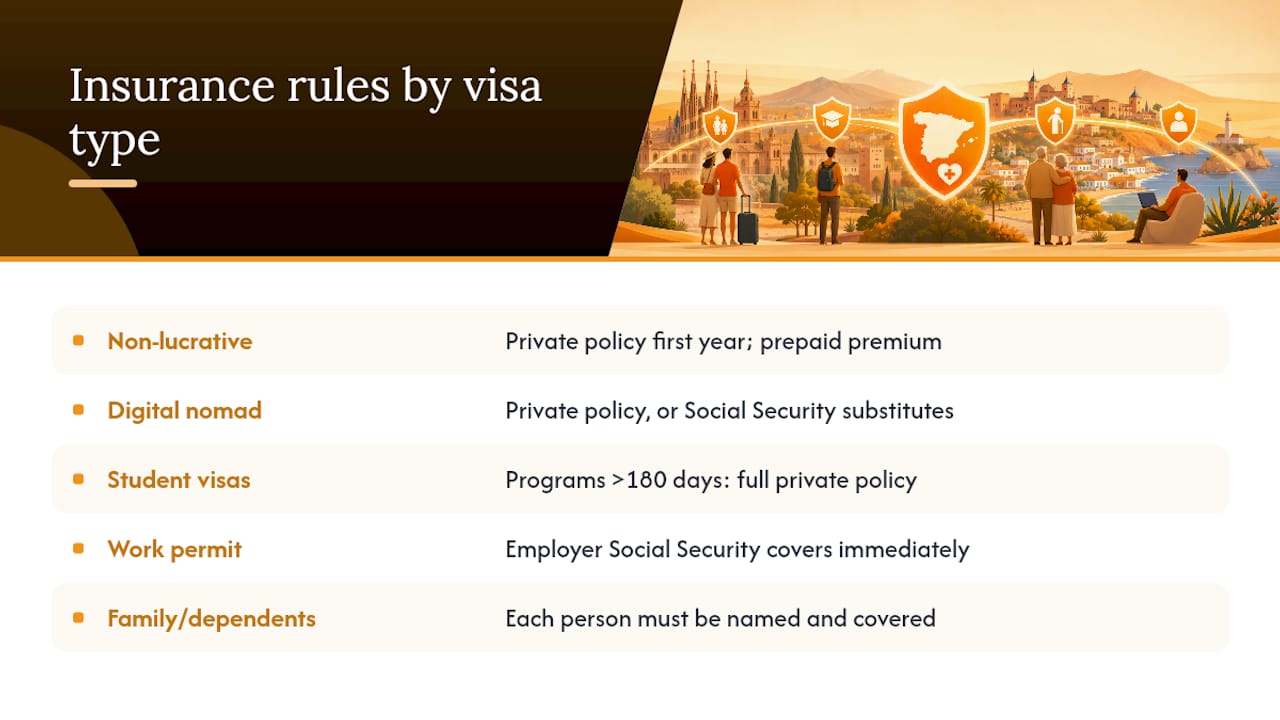
The non-lucrative visa is the strictest of the bunch. Applicants typically need a private policy covering the entire first year, and many consulates ask for proof that the premium payment has been duly made in advance. That upfront cost surprises a lot of applicants who assumed monthly billing would be fine. Renewals carry the same requirement, so you're planning this cost every year you hold the permit.
The digital nomad visa works differently. A private policy usually satisfies the requirement, but if you register with Spanish Social Security, either as an employee or as an autónomo, that public registration replaces the need for private insurance. According to a visa-by-visa comparison from Spain Handbook, this is one of the few routes where Social Security contributions can substitute for a private certificate entirely.
Student visas hinge on program length. Study programs lasting more than 180 days trigger the same residency-level private insurance standard as any other long-stay permit. Shorter programs sometimes follow lighter rules, so confirm the threshold with your specific consulate before assuming your semester abroad needs a full annual policy.
Work permits tend to be the simplest case. Once your employer registers you with Social Security, public healthcare coverage usually satisfies the requirement from day one, since registration is an employer obligation built into the hiring process.
If you're applying with family members or dependents, every single person listed on the application needs their own coverage under the policy; a certificate that only names the primary applicant will be sent back.
Getting a Compliant Certificate and Timing It Right
Buying insurance in the wrong order is one of the most common ways applicants delay their own case. Here's the sequence that avoids that.
- Confirm your visa type and consulate-specific rules first. Some posts require the policy to start on a set date, others want payment proof before scheduling the appointment, and a few require translated certificates even for English-language policies. A documentary review across five consulates found the core legal requirement identical everywhere, but details like validity dates and payment format differed post to post.
- Choose an insurer on the DGSFP register and request a certificate that states sin copagos, sin carencias, and repatriation explicitly. Don't accept a generic policy summary; ask for the certificate wording by name.
- Match your start date to your entry or visa date, and keep every receipt. For non-lucrative applications especially, an annual payment receipt often has to accompany the certificate.
- Get the certificate in Spanish, or attach a sworn translation, then gather originals and copies. Bring more paperwork than you think you need.
Your final folder should include the insurer certificate, the policy schedule listing every insured person, proof of payment, a medical certificate where the consulate requires one, your passport, and the completed application forms.
Pro Tip: Order two originals of your certificate from the insurer at the same time. Extranjería offices sometimes keep the original, leaving you without proof for a renewal appointment months later.
Why Do Consulates Reject Insurance Documents?
Most rejections trace back to a handful of repeat offenders, and nearly all of them are avoidable with a five-minute check before you submit.
- The insurer isn't authorized to operate in Spain, even if it's a major name in your home country
- The policy includes a copay, deductible, or per-visit fee buried in the fine print
- A waiting period applies to some conditions, even if the brochure calls it "standard practice"
- The certificate lists a start date that doesn't line up with your entry or visa date
- Payment proof is missing, incomplete, or doesn't match the premium amount stated on the policy
Before your appointment, verify a few things directly on the certificate itself: the insurer's identifying details, explicit "no copay" and "no waiting period" language, and that every name and date of birth matches your application exactly.
| Quick Pre-Appointment Check | Why It Matters |
|---|---|
| Certificate printed as an original, not a screenshot | Consulates and extranjería typically want the operative certificate document, not a policy quote |
| Spanish-language certificate or sworn translation attached | Some posts reject English-only paperwork outright |
| Payment receipt matches the premium on the policy schedule | Mismatched figures raise an immediate flag |
| Names and dates of birth match the application form | A typo here can stall an otherwise perfect file |
What Happens at Renewal Time?
Under Real Decreto 1155/2024, most residence permits follow an initial one-year term, then move to two-year renewal cycles, and you'll need to show maintained coverage at each renewal, not just at your first appointment.
If you register with Spanish Social Security at any point, whether as an employee or as an autónomo, private insurance may no longer be required going forward. Keep documentation of that registration date on hand, since it's what justifies dropping the private policy.
Switching insurers mid-residency is common, but do it carefully:
- Overlap your old and new policy by a few days rather than letting coverage lapse
- Get a fresh certificate from the new insurer listing every insured person on your file
- Avoid any gap in dates between the two certificates, since a gap is exactly what triggers extra scrutiny at renewal
Some long-term residents rely on the convenio especial, a public system buy-in agreement, but it has real limits worth knowing before you count on it.
What Do Most Applicants Get Wrong About Spain Visa Insurance?
A common issue seen with visa applicants isn't ignoring the insurance requirement but buying a policy that seems correct until a consulate officer finds a problematic clause. The fix is almost always the same: ask the insurer for a sample certificate in writing before paying anything, and read the actual clause language rather than trusting a sales summary.
CometoSpain provides tailored relocation assistance covering visa acquisition, self-employment registration, and management of documents like the NIE and TIE, with a dedicated relocation manager assigned to walk each client through every step. That structure exists because insurance is rarely the only thing that goes wrong in a filing. Our approval rate across visa applications sits at 98%, and most of that comes down to catching small, fixable documentation errors before they reach a consular officer's desk.
— CometoSpain
Get Help Securing a Compliant Insurance Certificate
Sorting out sin copagos wording, insurer authorization, and certificate translations on your own eats hours you probably don't have if you're also packing, closing out a lease, or coordinating a work contract. Comprehensive relocation services may handle the insurance certificate alongside the rest of your visa file, so these documents arrive at your consulate appointment matched and consistent rather than assembled separately at the last minute.
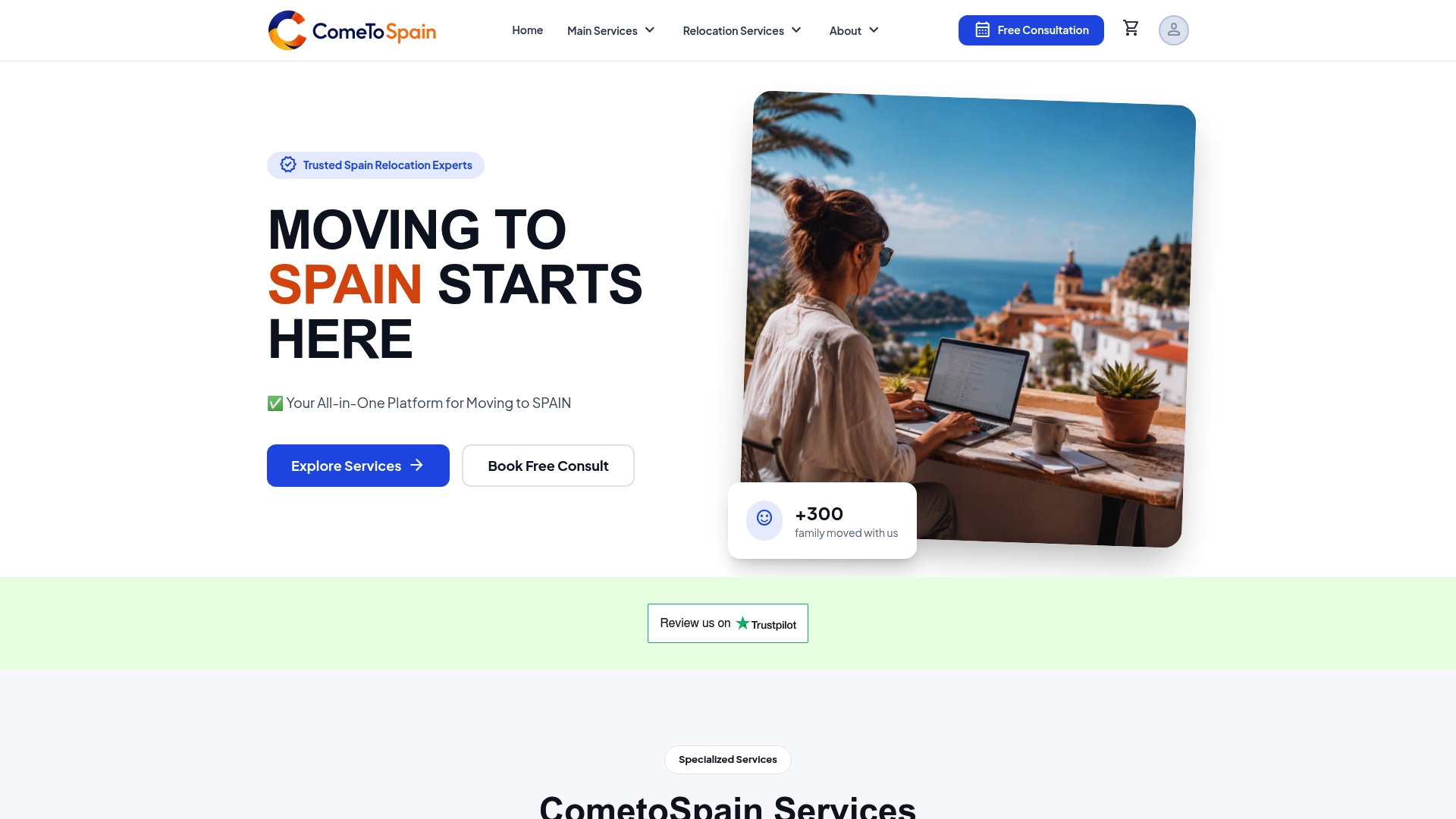
Our team maps private health insurance directly to your visa category, whether that's a non-lucrative application needing a prepaid annual premium or a digital nomad case where Social Security registration might replace private cover entirely. A dedicated relocation manager reviews your certificate wording, handles translation where needed, and confirms your payment receipts line up before submission. That kind of file review is part of why our clients see a 98% approval rate on visa applications.
If you want a second set of eyes on your insurance documents before your appointment, book a free consultation or review our full range of relocation services to see what fits your visa route.
Where to Verify These Rules Before Your Appointment
Insurance requirements are set nationally, but documentary details vary by consulate, so confirm the specifics with your own post before buying a policy.
- Real Decreto 1155/2024 guidance summary — Turner Insurance
- Consulate guidance (Houston) — non-lucrative visa requirements
- Consulate guidance (New York) — non-lucrative visa requirements
- Consulate-by-consulate insurance requirement comparison — Oficina Sanitas
Sources
- Consulate guidance (Houston) — residence non‑lucrative visa requirements
- Consulate guidance (New York) — residence non‑lucrative visa requirements
- Health Insurance for Spanish Residency & Visas (2026) — Turner Insurance
- Health insurance for each Spanish visa type — Spain Handbook (2026-06-05)
- Requisitos del seguro por consulado y visado (2026) — Oficina Sanitas