
File your AEAT census declaration (Modelo 036) first, then register in RETA through Import@ss before you start invoicing. That order matters more than almost anything else in this process, because doing it backward can cost you your reduced Social Security rate. Before either filing, have your NIE or TIE, a digital certificate or Cl@ve, and a Spanish IBAN ready. Once RETA is active, your monthly Social Security contribution starts counting from that exact date.
TL;DR:
- Registering in AEAT first with Modelo 036, including selecting the correct IAE code and VAT regime, is crucial to avoid future invoicing issues.
- Filing in RETA through Import@ss must be completed on the same day as AEAT registration to ensure eligibility for the tarifa plana and proper benefit calculations.
- The contribution base chosen during RETA registration directly affects future pension, sick leave, and unemployment benefits, making accurate selection important.
- Gathering and preparing all required documents—NIE or TIE, empadronamiento, IBAN, digital certificate or Cl@ve, and Social Security number—prevents delays and multiple paperwork repetitions.
- Hiring a professional becomes advisable when managing complex invoicing, multiple currencies, or visa-related requirements to avoid mistakes and optimize the registration process.
Table of Contents
- What Documents Do You Need Before Autonomo Registration in Spain?
- Who Can Register as Autonomo and What Do You Need First?
- How Do You Complete Modelo 036 for AEAT Registration?
- How Do You Register in RETA Through Import@ss?
- What Are Your Ongoing Tax Obligations as an Autonomo?
- What Does Autonomo Registration Cost in the First Year?
- What Mistakes Cause Fines or Lost Tarifa Plana Eligibility?
- When Should You Get Professional Help With Registration?
- What Do Most Clients Get Wrong About Autonomo Registration?
- Let CometoSpain Handle Your Autonomo Registration
- Sources
What Documents Do You Need Before Autonomo Registration in Spain?
Gathering paperwork twice is the single biggest time sink expats report during autonomo registration in Spain. Pull everything together once, in this order, and you'll move through both filings in a single sitting.
- NIE or TIE (or your EU registration certificate if you're an EU/EEA citizen): this is your tax identification number and nothing works without it.
- Empadronamiento (proof of municipal residence): several online systems, including parts of the RETA process, ask for a Spanish address on file with your town hall.
- Spanish IBAN: required for Social Security direct debit and often requested during AEAT registration too.
- Digital certificate (FNMT) or Cl@ve PIN: this is what lets you file online instead of booking an in-person appointment.
- Social Security number (NUSS): if you've never worked in Spain, you'll need to request this before RETA will accept your application.
- A decided IAE epígrafe, estimated income, and a rough sense of your IVA and IRPF situation: you'll need these figures the moment you open the Modelo 036 form.
Newcomers who arrive in Spain without a Social Security history sometimes assume the NUSS gets issued automatically. It doesn't always happen that way, and official guidance from the Ministry lists it as a distinct document you may need to request separately.
Who Can Register as Autonomo and What Do You Need First?
EU and EEA citizens benefit from freedom of establishment, which means you can register as autónomo with essentially the same paperwork a Spanish national would use: your EU registration certificate, empadronamiento, and a tax ID. Non-EU citizens face a different starting line. You generally need a residence permit that allows self-employed work (a cuenta propia authorization) before AEAT or Social Security will let you register at all. Trying to file without that underlying permission is the most common dead end non-EU freelancers hit.
Empadronamiento deserves attention early, because it's easy to underestimate. This is your registration with the local town hall confirming a Spanish address, and it feeds into everything from healthcare access to some Social Security forms. Book the appointment as soon as you have a lease or proof of address, since town halls in larger cities can have multi-week waits.
A digital certificate from the FNMT or a Cl@ve PIN is what separates a same-day online registration from a multi-week in-person slog. Cl@ve tends to be faster to obtain since it can sometimes be activated via video call, while the FNMT certificate usually requires an in-person identity verification appointment first.
- Request your NUSS at any Social Security office if you've never been assigned one, since RETA registration will not proceed without it.
- Confirm your empadronamiento certificate is recent. Some offices reject copies older than three months.
- Set up your Cl@ve or digital certificate before you touch either online form, not while you're mid-application.
Pro Tip: Book your empadronamiento and digital certificate appointments the same week you sign your lease. Both processes have wait times that run in parallel, so starting them together shaves real days off your total timeline.
How Do You Complete Modelo 036 for AEAT Registration?
Modelo 036 is the census declaration that registers you with the tax authority, and it's now the only version in use. Modelo 037, the shorter form once used by simpler cases, has been discontinued, so every autónomo files Modelo 036 through the AEAT portal regardless of activity type. This filing has to happen before you start any commercial activity, not after. Sending your first invoice before your AEAT alta is on record is one of the most common and most avoidable mistakes new freelancers make.
The form itself asks for more precision than most people expect on the first pass. Here's the sequence that matters:
- Select your IAE epígrafe. This code classifies your economic activity and determines which invoicing rules and obligations apply to you. Choosing a vague or incorrect code can create mismatches later when the tax authority cross-checks your invoices against your registered activity.
- Choose your IVA (VAT) regime. Most freelancers land in the general regime, but certain activities (education, some healthcare services, certain artistic work) qualify for VAT exemption. If you invoice clients in other EU countries, you'll also need to register for the intra-community VAT registry through this same form.
- Select your IRPF (income tax) method. The direct estimation method is standard for most autónomos and lets you deduct real business expenses. A simplified module system exists for select activities but has narrowed significantly in recent years.
- Confirm your registered address and activity start date. This date is what AEAT uses to determine when your obligations begin, so don't list a date earlier than you're actually ready to work.
One detail trips up a lot of freelancers with international clients: if you bill a business client in another EU country, the reverse charge mechanism usually applies, meaning you invoice without Spanish VAT and the client accounts for it in their own country. Getting the IAE epígrafe and IVA regime right on Modelo 036 is what makes that invoicing possible without a correction later.
You can submit Modelo 036 online through the AEAT portal using your digital certificate or Cl@ve, or in person at a tax office with an appointment. Either way, save the confirmation PDF the system generates. It's your proof of the exact registration date, and you'll want it if a discrepancy ever comes up.
How Do You Register in RETA Through Import@ss?
Your RETA registration date is the number that determines everything that comes after it, since your monthly Social Security contribution clock starts running from that exact day. Register a week later than you meant to, and you pay for a week you weren't technically covered, or worse, you create a gap between your AEAT alta and your RETA alta that raises questions during any future audit.
- Log into the Import@ss portal. The TGSS's Import@ss system accepts Cl@ve, a digital certificate, or in some cases a coordinated SMS verification if you've previously registered with Social Security. If none of those work for you yet, you'll need to book an in-person appointment at a TGSS office instead.
- Enter your economic activity details, which should mirror what you just declared on Modelo 036. Mismatches between your AEAT epígrafe and your RETA activity description are a known trigger for follow-up requests from the administration.
- Choose your contribution base. This figure, not your actual income, determines your monthly cuota and your future benefits, including sick leave pay, maternity or paternity leave, and eventual retirement calculations. A lower base means a smaller invoice now and a smaller safety net later.
- Select a mutual insurance provider for workplace accident and occupational illness coverage, a mandatory step in the RETA application.
- Set up your SEPA direct debit using the Spanish IBAN you gathered earlier. Social Security withdraws your cuota automatically each month, and a failed direct debit can trigger late fees even when the failure is a bank error.
Pro Tip: If your Import@ss session times out or rejects your ID verification, don't keep retrying online for hours. Book a same-week TGSS appointment instead. Chasing a broken online session often costs more time than just walking in.
Freelancers who registered with tight budgets sometimes pick the minimum contribution base to keep month one cheap. That's a reasonable short-term call, but understand the trade-off going in: your future unemployment benefit (the cese de actividad) and pension contributions are calculated from that base, not from what you actually earned.
What Are Your Ongoing Tax Obligations as an Autonomo?
Registration is the beginning, not the finish line. Every autónomo in Spain files on a quarterly rhythm, and missing these deadlines creates penalties on top of whatever tax you owe.
- Modelo 303 (VAT): filed quarterly, reporting VAT charged on your invoices minus VAT paid on deductible business expenses. The AEAT's current instructions for Modelo 303 walk through the exact fields, and deadlines fall in the first 20 days of April, July, and October, with a slightly extended January deadline for Q4.
- Modelo 130 or 131 (IRPF installments): Modelo 130 applies if you're on the direct estimation method, Modelo 131 if you're on modules. Both are quarterly installments against your annual income tax bill.
- Invoicing rules differ by client location. Domestic invoices carry standard IVA. EU business clients typically fall under the reverse charge mechanism. Non-EU clients are usually IVA-exempt as an export of services, but the exemption has to be stated correctly on the invoice itself.
- Basic bookkeeping means keeping every issued and received invoice, bank statements, and a running log of deductible expenses. This isn't optional busywork. It's what your quarterly filings are built from.
Many freelancers hit a point where the quarterly filings alone justify hiring a gestor, a Spanish tax and administrative professional. Monthly fees for a gestor handling routine autónomo bookkeeping and quarterly filings commonly land in a modest, predictable range, and for anyone billing multiple currencies or juggling reverse charge invoices, the fee tends to pay for itself in avoided errors alone.
What Does Autonomo Registration Cost in the First Year?
Spain's tarifa plana is the reduced flat Social Security rate available to new autónomos, significantly lowering first-year social security costs for those who qualify. It applies during an initial period and increases gradually rather than jumping straight to the full rate.
- Tarifa plana period: a reduced flat monthly contribution during your opening months as a new registrant, rising in stages afterward.
- Post tarifa plana monthly cuota: determined by your chosen contribution base, and it scales up the longer you're registered and the higher a base you select.
- Digital certificate or Cl@ve setup: typically free to obtain, though the in-person identity verification appointment can take time to book.
- Gestor fees: an ongoing monthly cost most freelancers weigh against the time and risk of self-filing quarterly returns.
Choosing the minimum contribution base keeps your monthly outlay low during a lean first year, but it directly shrinks your future sick leave pay, maternity or paternity benefit, and pension accrual. That's a real trade-off, not a technicality to skip past.
What Mistakes Cause Fines or Lost Tarifa Plana Eligibility?
The order of filings isn't a bureaucratic preference. Registering in RETA before your AEAT alta is confirmed can create a mismatch that jeopardizes your tarifa plana eligibility, since the reduced rate is tied to your status as a genuinely new registrant starting activity cleanly. Invoicing a client before your AEAT alta date is equally risky, since it creates a paper trail showing commercial activity before you were legally registered to have any.
- File AEAT first, confirm the alta, then move to RETA the same day if possible.
- Never send an invoice dated before your Modelo 036 confirmation.
- Save every confirmation PDF and screenshot, including your Import@ss confirmation, as proof of your exact registration date.
- Double check your SEPA direct debit went through after your first month, since a failed debit can trigger a late payment notice even when you did everything right.
- Understand that backdating your registration is limited. Once submitted, you generally can't shift your official start date earlier to claim benefits retroactively.
When Should You Get Professional Help With Registration?
Not every step requires a professional, but knowing which ones benefit from help saves real money. PAE and CIRCE centers offer assisted, in-person filing through a bundled Single Electronic Document, which distributes your registration to AEAT and Social Security in one visit. It's a solid option if you don't yet have a digital certificate. That said, PAE availability isn't uniform. A few provinces run different systems, so confirm your local center handles the full process before booking.
A gestor becomes worthwhile once your invoicing gets complex: multiple currencies, EU reverse charge clients, or mixed IVA treatment. A full relocation specialist makes sense when your autónomo registration is one piece of a bigger puzzle involving a visa, NIE, and TIE all at once.
- Ask any provider what happens if your application is rejected, not just what happens if it's approved.
- Confirm exact deliverables, timeline, and total fees before you commit.
Pro Tip: If you're juggling a visa application and autónomo registration simultaneously, get the immigration piece settled first. Social Security won't process a RETA alta for a non-EU applicant without valid work authorization already in place.
What Do Most Clients Get Wrong About Autonomo Registration?
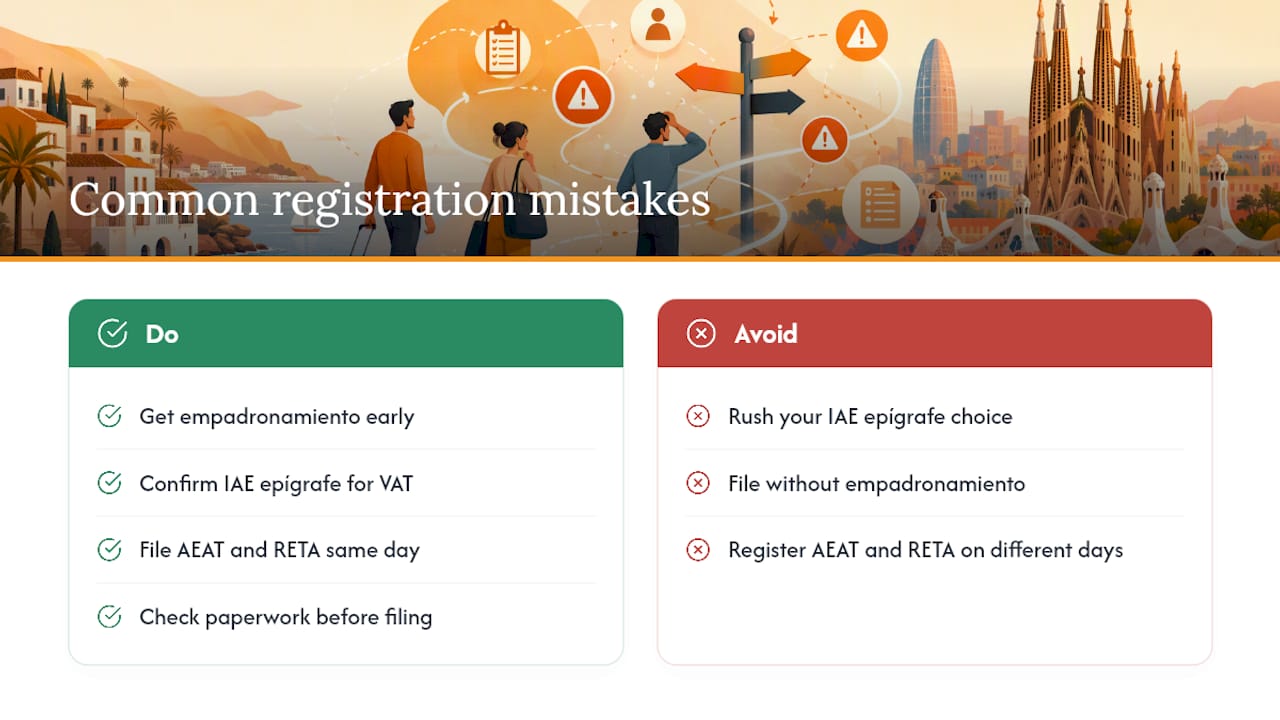
Most of the delays we see aren't caused by the tax forms themselves. They're caused by missing empadronamiento or a rushed IAE epígrafe choice made without checking how it affects VAT treatment down the line. Get those two things right early, and the rest of the process moves fast.
Our practical advice, drawn from watching this play out repeatedly: aim to file your AEAT alta and your RETA registration on the same day whenever your paperwork allows it. That single habit closes the gap where tarifa plana eligibility and invoicing dates get questioned later.
— CometoSpain
Let CometoSpain Handle Your Autonomo Registration
Cometospain is the alternative to piecing this process together from scattered official portals and translated forms. Instead of juggling AEAT, Import@ss, empadronamiento appointments, and a digital certificate application on your own timeline, our self-employment registration service handles the filings in the correct order, with a dedicated relocation manager tracking every deadline for you.
Here's what we take off your plate:
- Filing your AEAT Modelo 036 with the correct IAE epígrafe and IVA regime for your actual client base.
- Registering your RETA alta through Import@ss, including contribution base guidance and mutual insurance selection.
- Coordinating your NIE application and Social Security number request if you don't have either yet.
- Booking and managing the administrative appointments that can otherwise eat weeks of your calendar.
Before you start, have your passport or ID, proof of address, and a rough sense of your expected income ready. From there, book a free consultation and we'll map out exactly which filings you need and in what order, so your first invoice as an autónomo is backed by paperwork that's actually in place.
Sources
- AEAT — Procedimiento alta (Modelo 036/037)
- Import@ss — Alta trabajo autónomo
- Plataforma One — Registration of individual entrepreneurs (self-employed)
- General Sub-Directorate for Independent Work (SGTA) — Registration guidance